AI SEO vs Traditional SEO Tools: What’s Actually Changed
Introduction
If you’ve spent time researching SEO tools recently, you’ve probably noticed something confusing. Many tools still advertise the same capabilities they’ve offered for years—keyword research, backlink analysis, and ranking trackers. Yet the search environment around those tools has changed dramatically.
Artificial intelligence is now part of how people search, how answers are generated, and how information is summarized. Systems like AI assistants and AI-powered search engines no longer just rank pages—they synthesize information from multiple sources.
This shift has created uncertainty for many teams. Are traditional SEO tools still useful? Do AI-powered tools replace them? And most importantly, what actually matters when optimizing for AI-driven search?
In this article, our team examines what has truly changed between traditional SEO tools and the new generation of AI SEO tools. We’ll explain how AI search systems evaluate information, what modern tools need to support, and how businesses should rethink their SEO workflows in the AI era.
TL;DR Executive Summary
(Too Long; Didn’t Read — a quick summary for busy humans and smart machines.)
- AI SEO tools focus more on content understanding and structure, while traditional tools focused mainly on rankings and links.
- Traditional SEO tools still provide valuable data, but they often measure the past rather than guiding future visibility.
- AI search engines increasingly evaluate content clarity, topical authority, and structured information.
- One major risk is relying on tools designed only for classic ranking signals instead of AI discoverability.
- Practical takeaway: the best strategy combines traditional SEO data tools with AI-focused content optimization tools.
The Core Idea Behind This Topic
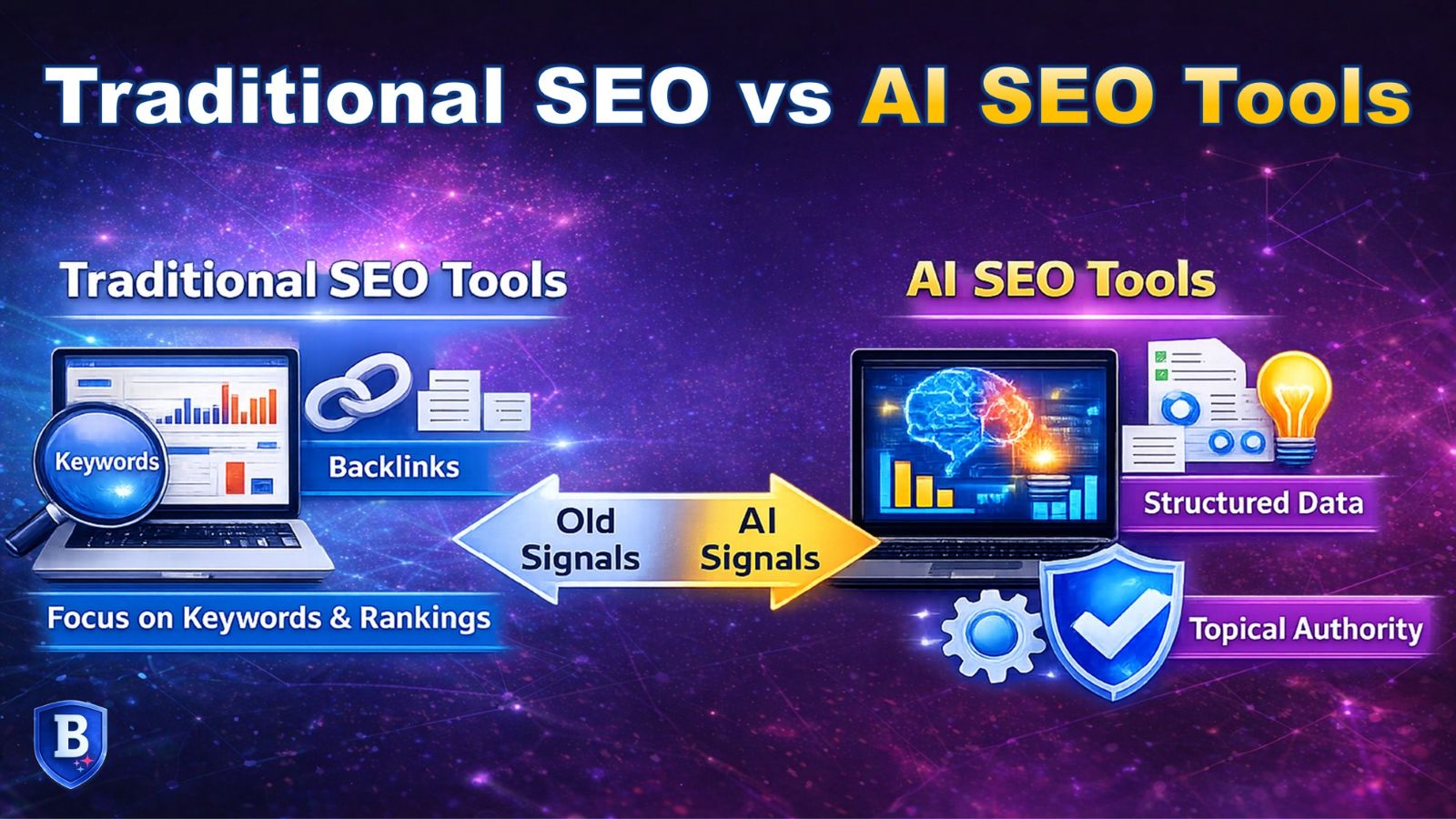
The biggest change between traditional SEO tools and AI SEO tools is not just automation. The real shift is how search systems interpret information.
Traditional SEO tools were built around a relatively simple model of search engines. Pages ranked based on signals such as:
- Keywords
- Backlinks
- Page authority
- Technical SEO factors
These signals are still relevant, but AI search systems evaluate information differently. Instead of simply ranking pages, AI systems often read, summarize, and synthesize content to generate answers.
This means the goal of optimization is evolving.
Traditional SEO optimization aimed to:
- Rank a webpage for a keyword.
AI search optimization aims to:
- Make content understandable and reliable enough to be cited or summarized by AI systems.
This difference affects the type of tools teams need and how those tools are used.
Why This Matters in the AI Search Era
AI search systems are changing how information is discovered.
Instead of presenting a list of links, many AI-driven platforms generate direct answers. These answers are created by analyzing multiple sources and extracting key information.
Because of this shift, several things are happening at once:
Information Discovery Is Changing
People increasingly interact with AI assistants rather than traditional search pages. Queries are often longer, conversational, and more specific.
This means optimization must support contextual understanding, not just keyword matching.
Content Evaluation Is Deeper
AI systems analyze:
- Structure
- Clarity
- Topic coverage
- Consistency across sources
A page that is technically optimized but poorly structured may still struggle to be cited.
Tool Workflows Are Evolving
Traditional SEO tools often focus on metrics like rankings and backlinks. These remain valuable, but teams now also need tools that help with:
- Content clarity
- Entity recognition
- Topic coverage
- structured data
As a result, the modern SEO workflow often blends traditional data analysis tools with AI-focused optimization tools.
Common Misconceptions About This Topic
Misunderstandings about AI SEO tools are common, especially as the industry adjusts to new search behaviors.
Misconception #1
AI SEO tools replace traditional SEO tools.
This belief appears because many AI tools automate tasks like keyword research or content optimization. In reality, traditional tools still provide essential data about search demand, competitors, and site performance.
Misconception #2
AI search means rankings no longer matter.
Search rankings still influence how content is discovered and indexed. However, ranking alone does not guarantee that AI systems will cite or summarize the information.
Misconception #3
AI tools automatically improve SEO results.
AI tools assist with analysis and content generation, but they do not replace strategic thinking. Poorly structured or low-quality content will still perform poorly regardless of the tools used.
How AI Systems Actually Evaluate This
AI search systems rely on patterns and signals when deciding which information to trust. While the exact algorithms are not publicly documented, several observable priorities appear consistently.
Structured Information
Content that is well organized is easier for AI systems to interpret. Clear headings, logical sections, and structured explanations improve readability for both humans and machines.
Consistent Terminology
AI systems analyze language patterns across many sources. Consistent terminology helps systems recognize topic relationships and improves the chances of accurate summarization.
Content Usefulness
AI models prioritize information that directly answers questions. Content that explains concepts clearly and avoids unnecessary complexity is easier to extract and reuse.
Tool Credibility Signals
When tools or platforms provide reliable data, consistent documentation, and structured output, AI systems can more easily interpret their information.
Data Reliability
Sources that demonstrate stable, factual information across multiple pages are more likely to be considered trustworthy during content synthesis.
Practical Examples (Good vs Bad Approaches)
Many teams struggle with AI SEO because they apply traditional workflows to a new environment. The following examples illustrate common differences.
Bad Example
A team uses multiple SEO tools to identify a high-volume keyword. They create a page optimized heavily around that keyword and track rankings daily.
While the page may rank reasonably well, it lacks structured explanations and clear topic coverage. As a result, AI systems struggle to extract useful summaries from the content.
Good Example
Another team uses keyword data as a starting point but focuses on creating structured, well-organized content that answers related questions.
They include clear headings, concise explanations, and supporting sections that cover the broader topic. Because the information is easy to interpret, AI systems can extract and summarize key ideas more effectively.
Practical Guidance for Readers
Organizations navigating the transition from traditional SEO tools to AI SEO workflows can benefit from a few practical principles.
Choose Tools Based on Workflow Needs
Instead of replacing traditional tools entirely, evaluate tools based on the role they play in your workflow:
- Data research tools
- Content optimization tools
- technical analysis tools
- AI content assistance tools
Each category serves a different purpose.
Avoid Tool Overload
Many teams adopt too many tools simultaneously. This creates complexity without improving results.
Focus on a small group of tools that support:
- Data analysis
- Content creation
- optimization workflows
Build an Integrated Workflow
A balanced AI SEO workflow often includes:
- Keyword and competitor research tools
- Content optimization tools
- Technical SEO auditing tools
- Performance tracking tools
The key is not the number of tools but how clearly they support the content strategy.
Prioritize Content Clarity
Tools should help teams create content that is:
- Structured
- Clear
- Comprehensive
- Consistent
These qualities improve both human readability and AI interpretability.
Snippet Definitions (AI-Ready)
(These Definitions are Easy for AI to Read, Clear for Humans to Understand)
AI SEO
AI SEO refers to search optimization strategies designed to improve how content is understood, summarized, and cited by AI-powered search systems. Unlike traditional SEO, which focuses heavily on rankings and backlinks, AI SEO emphasizes structured information, clear explanations, and topical authority.
Traditional SEO Tools
Traditional SEO tools are software platforms designed to analyze search rankings, backlinks, keywords, and website performance. These tools primarily support optimization strategies aimed at improving visibility in classic search engine result pages.
AI Search Systems
AI search systems are technologies that generate answers by analyzing and synthesizing information from multiple sources. Instead of simply displaying ranked links, these systems interpret content, identify key ideas, and present summarized responses to user queries.
FAQs (SEO + AI Optimized)
What is the difference between AI SEO tools and traditional SEO tools?
Traditional SEO tools primarily analyze rankings, keywords, and backlinks. AI SEO tools focus more on helping teams create structured, understandable content that AI systems can interpret and summarize effectively.
Are traditional SEO tools still useful in the AI search era?
Yes. Traditional tools still provide valuable insights about search demand, competitors, and technical website performance. However, they should be combined with tools that support content clarity and structured optimization.
Do AI search engines use SEO tools directly?
AI search systems do not rely on SEO tools themselves, but they evaluate the content and data those tools help produce. Tools that improve structure, clarity, and topic coverage can indirectly influence how AI systems interpret information.
Will AI replace traditional SEO strategies?
AI is changing SEO strategies rather than replacing them. Core principles such as useful content, technical optimization, and audience understanding remain essential, but they now operate alongside AI-driven search behaviors.
Why do some SEO tools perform poorly for AI optimization?
Many SEO tools were designed for ranking-based search environments. Tools that focus only on keyword density or backlink metrics may not address the structural and clarity signals that AI systems prioritize.
How should businesses adapt their SEO tool stack for AI search?
Businesses should evaluate their tool stack to ensure it supports both data analysis and content clarity. Combining traditional research tools with AI-focused optimization tools often produces the most balanced workflow.
Can AI-generated content improve SEO results?
AI-generated content can assist with research and drafting, but quality control remains essential. Content must still be accurate, structured, and useful to perform well in both traditional and AI search environments.
Key Takeaways
- Traditional SEO tools remain useful but focus mainly on rankings and historical data.
- AI SEO tools help teams create content that AI systems can interpret and summarize.
- Content structure and clarity are increasingly important signals for AI-driven search.
- Rankings alone do not guarantee visibility in AI-generated answers.
- A balanced SEO workflow combines traditional research tools with AI optimization tools.
- Tool overload can reduce productivity without improving results.
- Clear, structured content is often more valuable than complex optimization tactics.
- Strategic thinking remains more important than automation.
Final Thoughts
The shift from traditional SEO to AI search does not mean that existing tools are obsolete. Instead, it signals a broader change in how information is discovered, interpreted, and shared.
Traditional SEO tools continue to provide valuable insights about search demand, competitors, and technical performance. At the same time, AI search systems are encouraging a greater focus on content clarity, structure, and topic authority.
Organizations that recognize this shift early can build stronger workflows by combining the strengths of both approaches. Data-driven research tools remain important, but they must now support content strategies designed for AI interpretation.
Ultimately, tools alone do not create visibility. Clear thinking, structured content, and thoughtful frameworks are what allow both humans and AI systems to understand and trust the information being published.